


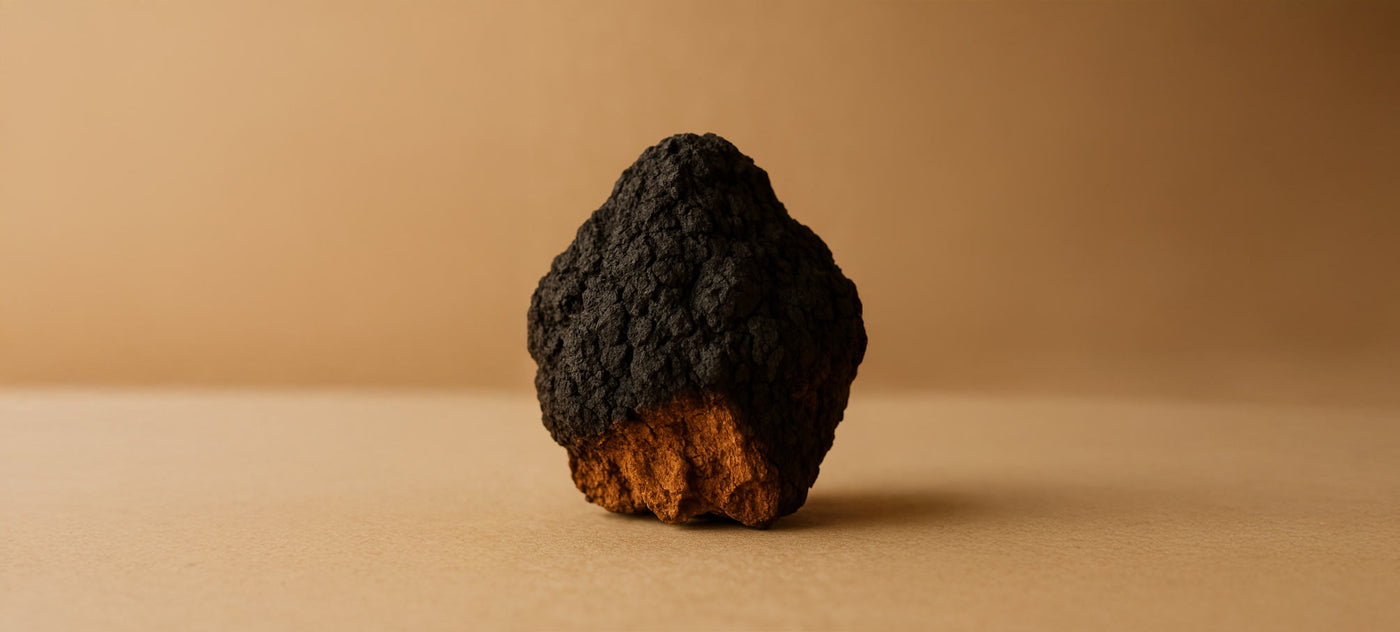

ESSENTIAL NOTES ON “THE BLACK PEARL”
Chaga stands out for the amount and variety of its polysaccharides, and it also contains naturally occurring polyphenols. Like Lion's Mane, Chaga has long been part of food culture in Northern Europe, where the concentrated powder was brewed with hot water (zavarka). In the 1960s, Finnish, American and Russian scientists began to study its extracts.

CHAGA: HISTORY AND EXTRACTS
In the West, interest in Chaga grew following these early studies. Known as the ‘Black Pearl’ or the ‘Diamond of the Forest’, Chaga has since been studied by modern science, and analyses show that it contains polysaccharides and naturally occurring polyphenols. The presence of these compounds has encouraged its controlled cultivation and extraction.
An extract is a concentrated form of the compounds found in Chaga. It is available as a powder in capsules in Mico-Chaga and Mico-Five, and in liquid form in Dr. Immune Five.
Today, extracts can be obtained using sustainable technologies designed not to denature their compounds. Premium-quality production aims to keep the same amount of polysaccharides and terpenes from batch to batch.
Products with Chaga
-

 TRENDINGHasta - 10 %
Dr. Immune Five Syrup (Reishi, Agaricus, Oyster, Chaga, Shiitake)
KIDS' SYRUP WITH VITAMINS C & D
From 30,00 €Unit price /Unavailable -

 TRENDINGHasta - 10 %
Hifas-Neuro Lion's Mane & Chaga plant-based capsules
WITH LION'S MANE & CHAGA
From 42,50 €Unit price /Unavailable -

 Hasta - 10 %
Mico-Chaga: Pure Organic Extract Capsules
ORGANIC CHAGA + VITAMIN C
From 50,00 €Unit price /Unavailable


CHAGA CULTIVATION
Chaga is not as easy to cultivate as other species such as Lion's Mane. Today, most Chaga is still harvested in the wild in Scandinavian and Siberian forests. However, techniques for growing its mycelium in bioreactors have been developed successfully. Our R&D work with Inonotus obliquus has allowed us to confirm that it can be grown in this way.
After selecting the most suitable strains and optimising its organic production and extraction process, Chaga has recently been added to the Hifas Mycological Bank (HMB).
Featured Biomolecules
This species has active biomolecules, including:


Do you want to know more?
Habitat and distribution
Habitat and distribution
In northern and eastern Europe, especially in Siberia, there are vast birch forests. It is therefore no surprise to find wild Chaga growing in the forests of these latitudes.
Mycological notes
Mycological notes
Chaga is a fungus that lives with its host, a weakened birch tree, growing alongside it over a long period of time. This mushroom can take 20 to 30 years to form a black, tuber-like mass the size of a child's head. This structure does not look like the fruiting body of a typical mushroom, and the sclerotium is found inside the colonised birch. Both parts have a very characteristic brown colour, due to their high production of melanin, the same pigment that makes our skin tan in the sun.
Bioreactor cultivation
Bioreactor cultivation
Quality, Purity, and Consistency in Our Production Systems
Our commitment to excellence is reflected in our strict quality assurance standards, ensuring purity and consistent quality across our products.
R&D and Chaga Studies
R&D and Chaga Studies
- Hifas da Terra carries out ongoing research to optimize its mushroom production processes and to develop new biotechnology-based botanical ingredients.
- In its extensive strain collection (Hifas Mycological Bank), Hifas da Terra keeps its own strains isolated in the Iberian Peninsula, which it selects to develop its formulas.
- Hifas da Terra carries out technical research projects in partnership with independent research centres and universities.
Curiosities
Curiosities
- Chaga has become increasingly popular in recent years.
- Unlike most mushrooms, what is harvested is not a fruiting body but a black mass (sclerotium) that forms on the trunk of the birch.